Most yard drainage problems come down to water that has nowhere to soak in and nowhere safe to go, so it sits in the lawn or runs toward your house. In eastern Connecticut the usual causes are dense clay, shallow ledge, compacted soil and slopes that point the wrong way. The fix is to find where the water starts, then regrade, redirect or slow it down before it reaches your foundation.
At a glance
- Puddles that last more than a day after rain are the clearest sign of a drainage problem.
- Soil should fall away from the house, about 6 inches over the first 10 feet.
- Downspouts should empty well away from the foundation, at least 5 feet out.
- Steep, eroding slopes often need terracing with a retaining wall.
- Wet-tolerant plants help in low spots but will not fix a grading problem alone.
Signs of yard drainage problems
Most homeowners think their yard drains fine until the basement gets wet. Walk the lot during or right after a heavy rain and look for these:
- Standing water in the lawn or beds a day or more after the storm.
- Soggy, spongy turf, moss or thin grass in the same spot every spring.
- Mulch and soil washed out of beds or piled up on walkways.
- Small gullies or bare channels running down a slope.
- Water pooling against the foundation, damp basement walls or a musty smell.
- Patios, walks or driveways that tilt toward the house or hold water.
- Ice sheets forming in the same low spots every winter.
- Moss and mildew on north-facing walls where shade and moisture stay trapped.
Why eastern Connecticut yards hold water
From Hebron and Columbia up through Tolland, Mansfield and Willington, the ground was shaped by glaciers. That leaves a few common problems.
Clay and compacted till
Glacial till is a mix of stones, sand and fine silt or clay packed tight. Some pockets drain slowly no matter what you plant. Construction traffic makes it worse by crushing the soil around new homes.
Shallow ledge
Many lots have bedrock close to the surface. Rain soaks down a few inches, hits rock and spreads sideways, often right toward a foundation or a low corner of the yard.
Slopes and grading
Hilly lots move a lot of water fast. If the grade near the house has settled over time, or a patio was set without enough pitch, water collects where you least want it.
Weather
Heavy spring rain, snowmelt, nor’easters and freeze and thaw cycles all push extra water through the yard at once. Frozen ground cannot absorb anything, so melt runs off the surface.
Rather have a crew handle it? High Vibe Gardens does this work across eastern Connecticut. Get a free walkthrough and same-day quote or call (860) 791-3191.
How to fix yard drainage problems
Start with the cheapest fix that addresses the cause, and work up from there.
1. Route downspouts away from the house
A downspout that dumps at the foundation can put a lot of water in one spot every storm. Extend it or route it through buried pipe to a spot at least 5 feet out that slopes away. Note that we do not clean or install gutters. We handle where the water goes once it leaves the downspout.
2. Regrade the soil
Build the soil up against the house so it falls away, about 6 inches over the first 10 feet. Fill low spots in the lawn with good soil and reseed. This one step fixes a lot of wet basements.
3. Terrace slopes with retaining walls
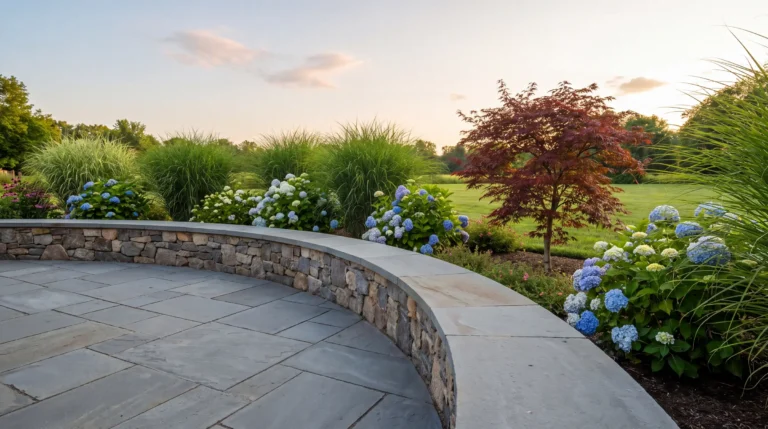
On steep ground, a retaining wall breaks one long slope into flatter steps. Water slows down, soaks in and stops carving gullies. Walls also create level space for beds or a patio.
4. Add a dry well or French drain
Where water collects with nowhere to go, a gravel trench with pipe (a French drain) or a buried dry well can carry it off or let it soak in slowly. On shallow ledge these need careful planning.
5. Plant for wet ground
In low spots, wet-tolerant shrubs such as red osier dogwood soak up water and hold soil in place. A rain garden planted with native species can handle runoff from a roof or driveway. Loosening compacted soil and working in compost also helps water soak in.
6. Plan hardscape drainage from the start
New patios, walkways and driveways should pitch away from the house. Permeable pavers let some water pass through instead of sheeting off.
Keep drainage fixes working
- Keep mulch 2 to 3 inches deep so it stays put in a downpour.
- Keep downspout outlets and drain inlets free of leaves each fall.
- Check the grade near the house every few years. Soil settles.
- Walk the yard after big storms and note any new wet spots.
- If your lot borders a wetland or stream, check with your town before regrading near it.
When to call a pro
Call for help when water is reaching the foundation, a slope keeps washing out, or you have tried the easy fixes and the same spot is still wet.
High Vibe Gardens is a family-owned crew based in Hebron, serving eastern Connecticut. We regrade yards, route downspout runoff and build retaining walls and handle excavation with our local partner Tom Sullivan. We also replant disturbed areas through our garden bed planting and mulching work. We carry $2M in liability insurance and hold 6 industry certifications. Local homeowners can see more on our Hebron CT landscaping page.
Book a free on-site walkthrough. We will watch where the water goes, explain the options and give you a same-day quote. Call or text (860) 791-3191 or send us a message.
Common questions
How do I know if my yard has a drainage problem?
Water that stands in the lawn a day or more after rain, soggy turf, washed-out mulch and water pooling against the foundation are the main signs. Walk the yard during a heavy rain to see where the water goes.
Why does my Connecticut yard stay wet?
Many eastern Connecticut yards sit on dense glacial till, clay pockets or shallow ledge, so water cannot soak in. Slopes and settled grading can then send it toward the house.
How far should a downspout drain from my house?
Route downspout water at least 5 feet from the foundation to a spot that slopes away. Farther is better on flat or clay-heavy lots.
Can plants fix yard drainage problems?
Plants help. Wet-tolerant shrubs and rain gardens soak up water and hold soil, but they will not fix grading that sends water toward the house.
Do you clean or install gutters?
No. We do not do gutters. We handle where the water goes after it leaves the downspout, along with regrading, retaining walls and planting.